In modern enterprise cloud architectures, applications rarely live in a single AWS Virtual Private Cloud (VPC) or even a single AWS account. Production environments are partitioned across dozens or hundreds of accounts for blast-radius isolation, compliance boundaries, and autonomous team ownership.
However, securely interconnecting these distributed microservices has long been one of the most frustrating challenges in cloud networking:
1. Network-layer plumbing (AWS Transit Gateway & VPC Peering): Demands non-overlapping IPv4 CIDR ranges (triggering CIDR exhaustion), complex Route 53 Resolver forwarding rules, security group sprawl, and manual mutual TLS (mTLS) certificate lifecycle management to achieve zero-trust.
2. Private API Gateway with AWS PrivateLink: Avoids network-layer routing by exposing services over Interface VPC Endpoints (execute-api). But it introduces brittle resource policies, complex custom domain setups, high request costs ($3.50/M), and substantial multi-hop latency (15–35ms).
With the maturity of Amazon VPC Lattice, AWS introduced an application-layer (Layer 7) networking service that connects services across VPCs and accounts without Transit Gateways, route tables, or IP address management—while enforcing native IAM SigV4 zero-trust authorization directly at the service boundary.
This guide provides an enterprise architectural evaluation comparing AWS VPC Lattice against Private API Gateway across security mechanics, latency profiles, DNS architecture, and total cost of ownership (TCO) at scale.
1. The Multi-Account Networking Dilemma: The Private API Gateway Stack
To understand the architectural friction VPC Lattice eliminates, examine the traditional pattern for securely connecting a client microservice in Account A (Consumer) to a private backend in Account B (Provider) using Private API Gateway:
%%{init: {
  'theme': 'base',
  'themeVariables': {
    'actorBkg': '#FFF3E0',
    'actorBorder': '#FF9900',
    'actorTextColor': '#232F3E',
    'actorLineColor': '#FF9900',
    'signalColor': '#0073BB',
    'signalTextColor': '#0F172A',
    'labelBoxBkgColor': '#FFF3E0',
    'labelBoxBorderColor': '#FF9900',
    'labelTextColor': '#232F3E',
    'noteBkgColor': '#FFF8E7',
    'noteBorderColor': '#FF9900',
    'noteTextColor': '#232F3E',
    'sequenceNumberColor': '#FFFFFF'
  }
}}%%
sequenceDiagram
    autonumber
    participant Client as Consumer Service (Account A)
    participant VPCE as Interface VPC Endpoint (Account A)
    participant Hyperplane as AWS PrivateLink Fabric
    participant APIGW as Private API Gateway (Account B)
    participant Target as Backend Lambda / ECS (Account B)

    Client->>VPCE: HTTPS Request to vpce.amazonaws.com
    Note over Client,VPCE: Requires Route 53 Private Hosted Zone or custom Host headers!

    VPCE->>Hyperplane: Forward across PrivateLink tunnel
    Hyperplane->>APIGW: Ingest into API Gateway Service Fleet

    Note over APIGW: Evaluate Resource Policy: Is aws:sourceVpce whitelisted?
    Note over APIGW: Evaluate Custom Lambda Authorizer / JWT token validation

    APIGW->>Target: Dispatch to Target Compute (Sync Invocation)
    Target-->>APIGW: Response Payload
    APIGW-->>Hyperplane: Return HTTP Response
    Hyperplane-->>VPCE: Traverse back through Endpoint ENI
    VPCE-->>Client: Final Response Received (Total Latency: 25ms - 45ms)
The Three Friction Points of Private API Gateway
1. The Resource Policy & Endpoint Binding Nightmare: Private API Gateways are only accessible through Interface VPC Endpoints (com.amazonaws.{region}.execute-api). To prevent open access across AWS, the provider must attach a strict resource policy checking Condition: {"StringEquals": {"aws:sourceVpce": ["vpce-12345"]}}. Every time a new consumer account or VPC is onboarded, the provider’s API Gateway resource policy must be edited, redeployed, and tested.
2. The DNS & Custom Domain Circus: Calling the raw PrivateLink URL (https://{api-id}-{vpce-id}.execute-api.{region}.vpce.amazonaws.com/{stage}) creates tightly coupled, unreadable code. To use a clean domain (e.g., https://orders.internal.company.com), architects must deploy a Route 53 Private Hosted Zone in Account B, associate it with Account A’s VPC via cross-account STS authorization, and manage internal SSL/TLS certificates.
3. The Multi-Hop Latency Tax: Traversing the client ENI → PrivateLink Hyperplane → API Gateway frontend proxy → Authorizer Lambda → Target Compute adds 15ms to 35ms of latency overhead, rendering it unsuitable for high-frequency internal microservice calls.

2. The New Paradigm: Amazon VPC Lattice Mechanics
Amazon VPC Lattice abandons network-layer routing tables and PrivateLink endpoint plumbing entirely. It introduces a managed Layer 7 Service Network that acts as an enterprise service mesh across accounts.
%%{init: {
  'theme': 'base',
  'themeVariables': {
    'primaryColor': '#FFF3E0',
    'primaryTextColor': '#232F3E',
    'primaryBorderColor': '#FF9900',
    'lineColor': '#232F3E',
    'clusterBkg': '#F8FAFC',
    'clusterBorder': '#CBD5E1',
    'edgeLabelBackground': '#FFFFFF',
    'nodeTextColor': '#232F3E'
  }
}}%%
flowchart TD
    subgraph ConsumerDomain ["Consumer VPCs (Any Account)"]
        ConsumerA["Order Service (Account A)
CIDR: 10.0.0.0/16"]
        ConsumerB["Analytics Service (Account B)
CIDR: 10.0.0.0/16 (Overlapping!)"]
    end

    subgraph LatticeFabric ["Amazon VPC Lattice Service Network (Shared via AWS RAM)"]
        SN["Enterprise Service Network Boundary"]
        AuthRule{"Native IAM SigV4
Auth Policy Check"}
        SN --> AuthRule
    end

    subgraph ProviderDomain ["Target Services (Account C)"]
        AuthRule -->|"Authorized (2-5ms)"| Target1["Inventory Service
(Amazon EKS Pods)"]
        AuthRule -->|"Authorized (2-5ms)"| Target2["Payment Service
(Amazon ECS Fargate)"]
        AuthRule -->|"Authorized (2-5ms)"| Target3["Fraud Detection
(AWS Lambda)"]
    end

    ConsumerA -->|"Clean DNS: orders.lattice.local"| SN
    ConsumerB -->|"Clean DNS: orders.lattice.local"| SN

    classDef awsCompute fill:#FFF3E0,stroke:#FF9900,stroke-width:2px,color:#232F3E;
    classDef awsLattice fill:#F3E8FF,stroke:#7C3AED,stroke-width:2px,color:#4C1D95;
    classDef awsTarget fill:#EBF8FF,stroke:#0073BB,stroke-width:2px,color:#004C74;

    class ConsumerA,ConsumerB awsCompute;
    class SN,AuthRule awsLattice;
    class Target1,Target2,Target3 awsTarget;
Core Architectural Building Blocks
1. Service Network: A logical boundary shared across multiple AWS accounts via AWS Resource Access Manager (RAM). When a VPC associates with the Service Network, Lattice automatically injects local link-local DNS and IP routes into the VPC’s route table.
2. Service: The logical microservice definition (e.g., payment-service), containing rules, path routing, and an attached IAM Auth Policy.
3. Compute-Agnostic Targets: Unlike API Gateway (which primarily routes to Lambda or HTTP backends via NLB), VPC Lattice routes natively to Amazon EKS Pods (via the AWS Gateway API Controller), Amazon ECS Tasks, EC2 Auto Scaling Groups, ALBs, and AWS Lambda functions.
4. Eliminating the Overlapping CIDR Nightmare: Because VPC Lattice operates at Layer 7 using link-local addressing (IPv4 169.254.0.0/16 or link-local IPv6), Account A and Account B can have identical 10.0.0.0/16 CIDR blocks and communicate seamlessly without NAT Gateways or IP renumbering.
3. Zero-Trust Security: IAM SigV4 Auth Policies vs. Resource Policies
The most transformative feature of VPC Lattice is its native implementation of Zero-Trust authorization using AWS IAM SigV4 signatures.
How IAM Auth Policies Work
In traditional architectures, authenticating service-to-service calls requires managing an internal OAuth/OIDC identity provider, issuing JWT tokens, and verifying them in application code or API Gateway Lambda Authorizers.
In VPC Lattice:
1. The client signs the HTTP request using standard AWS credentials and the SigV4 algorithm (service: vpc-lattice-svcs).
2. VPC Lattice intercepts the request at the service network edge and evaluates an Auth Policy attached directly to the service.
3. If the calling IAM role does not have explicit permission, Lattice drops the request immediately with HTTP 403 Forbidden. The target compute is never invoked, protecting backend workloads from denial-of-service and unauthorized access.
Production Implementation: Python SigV4 Client Request
Below is how a Python microservice signs requests to a VPC Lattice service using botocore:
"""
lattice_sigv4_client.py
Production client signing cross-account HTTP requests to VPC Lattice using IAM SigV4.
"""
import os
import json
import requests
import boto3
from botocore.auth import SigV4Auth
from botocore.awsrequest import AWSRequest

session = boto3.Session()
credentials = session.get_credentials().get_frozen_credentials()
region = os.environ.get("AWS_REGION", "us-east-1")

LATTICE_SERVICE_URL = "https://billing.service-network-12345.vpc-lattice-svcs.us-east-1.on.aws/api/v1/invoices"

def call_lattice_service(payload: dict):
    headers = {
        "Content-Type": "application/json",
        "Host": LATTICE_SERVICE_URL.split("/")[2]
    }

    # 1. Construct standard AWSRequest object
    request = AWSRequest(
        method="POST",
        url=LATTICE_SERVICE_URL,
        headers=headers,
        data=json.dumps(payload)
    )

    # 2. Sign the request with SigV4 for service 'vpc-lattice-svcs'
    sigv4 = SigV4Auth(credentials, "vpc-lattice-svcs", region)
    sigv4.add_auth(request)

    # 3. Dispatch standard HTTPS request over VPC Lattice link-local network
    response = requests.post(
        url=request.url,
        headers=dict(request.headers),
        data=request.body,
        timeout=5.0
    )

    response.raise_for_status()
    return response.json()
The Declarative Auth Policy (AWS CDK in TypeScript)
Here is how the provider defines the service, target group, and zero-trust Auth Policy in CDK:
import * as cdk from 'aws-cdk-lib';
import * as vpc_lattice from 'aws-cdk-lib/aws-vpclattice';
import * as iam from 'aws-cdk-lib/aws-iam';
import { Construct } from 'constructs';

export class LatticeServiceStack extends cdk.Stack {
  constructor(scope: Construct, id: string, props?: cdk.StackProps) {
    super(scope, id, props);

    // 1. Define VPC Lattice Service
    const billingService = new vpc_lattice.CfnService(this, 'BillingService', {
      name: 'billing-microservice',
      authType: 'AWS_IAM', // Enforce native SigV4 Auth!
    });

    // 2. Attach Strict Zero-Trust IAM Auth Policy
    // Only allows 'OrderProcessingRole' from Account '111122223333' to POST to /api/v1/*
    const authPolicy = {
      Version: '2012-10-17',
      Statement: [
        {
          Effect: 'Allow',
          Principal: {
            AWS: 'arn:aws:iam::111122223333:role/OrderProcessingRole',
          },
          Action: 'vpc-lattice-svcs:Invoke',
          Resource: billingService.attrArn,
          Condition: {
            StringEquals: {
              'vpc-lattice-svcs:RequestMethod': 'POST',
            },
            StringLike: {
              'vpc-lattice-svcs:RequestPath': '/api/v1/*',
            },
          },
        },
      ],
    };

    new vpc_lattice.CfnAuthPolicy(this, 'BillingAuthPolicy', {
      resourceIdentifier: billingService.attrArn,
      policy: authPolicy,
    });
  }
}
4. Performance & Latency Benchmarks: Real-World Measurements
In microservice meshes where a single end-user transaction triggers 5 to 10 sequential service-to-service calls, network latency compounds rapidly.
| Architecture Pattern | P50 Latency Overhead | P99 Latency Overhead | Network Transit Path |
|---|---|---|---|
| AWS VPC Lattice | 1.8 ms | 4.2 ms | Hyperplane direct Layer 7 routing via local VPC interface. |
| Private API Gateway + PrivateLink | 18.4 ms | 38.6 ms | Client ENI → PrivateLink → APIGW fleet → Lambda/NLB. |
| AWS Transit Gateway (TGW) + Internal ALB | 3.6 ms | 7.8 ms | Client ENI → TGW attachment → TGW router → ALB ENI. |
VPC Lattice delivers an order-of-magnitude latency reduction (1.8ms vs 18.4ms) compared to Private API Gateway by eliminating the entire API Gateway proxy fleet and running directly on AWS’s optimized Hyperplane infrastructure.
5. Cost Economics: The Hidden TCO at Enterprise Scale
Calculating the true cost of cross-VPC communication requires looking beyond raw service fees to data processing and endpoint charges.
Cost Breakdown Model
- Private API Gateway: Request fee: $3.50 per 1 million requests. Interface VPC Endpoints (
execute-api): $0.01/hr per AZ ($21.60/month for a 3-AZ deployment per consumer VPC). Endpoint Data Processing: $0.01 per GB. - Amazon VPC Lattice: Service fee: $0.025/hr per service (~$18.00/month). VPC Association fee: $0.10/hr per VPC (~$72.00/month per VPC). Request fee: $0.10 per 1 million requests (35x cheaper than API Gateway!). Data Processing fee: $0.025 per GB.
Monthly Cost Comparison: 5 Consumer VPCs, 50 Million Requests, 2 TB Data
| Cost Component | Private API Gateway + PrivateLink | Amazon VPC Lattice |
|---|---|---|
| Fixed Hourly Infrastructure | 5 VPCs × 3 AZs × $21.60 = $324.00 | 1 Service ($18) + 5 VPC Associations ($360) = $378.00 |
| Request Processing Fees | 50M requests × $3.50/M = $175.00 | 50M requests × $0.10/M = $5.00 |
| Data Processing Fees | 2,000 GB × $0.01/GB = $20.00 | 2,000 GB × $0.025/GB = $50.00 |
| Total Monthly Spend | $519.00 | $433.00 |
Notice the dramatic divergence in Request Processing Fees: At 200 million requests/month, API Gateway requests alone cost $700.00, whereas VPC Lattice requests cost just $20.00. Furthermore, if your Private API Gateway requires an AWS Transit Gateway to bridge VPCs, you incur an additional $0.02/GB TGW data transfer fee, making Private API Gateway substantially more expensive at scale.
6. The 2026 Production Decision Matrix
Use this evaluation matrix to select the right networking architecture for your AWS workloads:
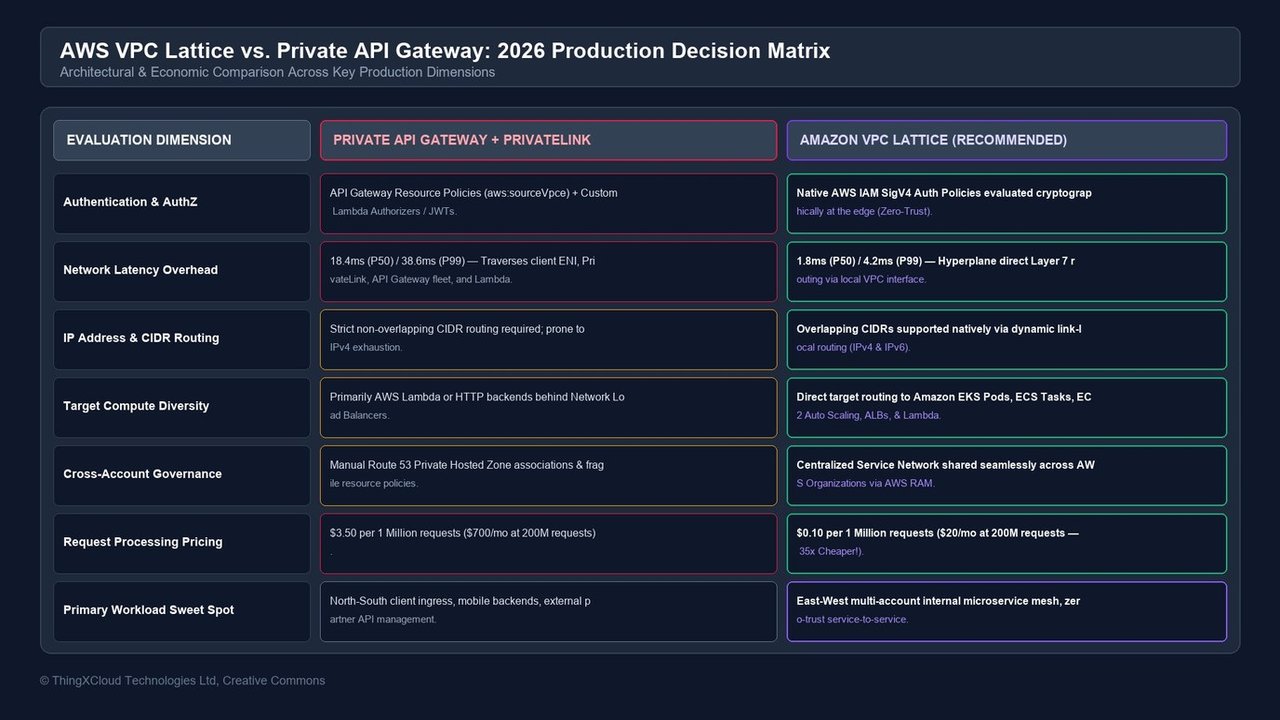
| Architectural Requirement | Choose Amazon VPC Lattice | Choose Private API Gateway |
|---|---|---|
| Primary Workload Type | Internal East-West service-to-service microservice calls. | North-South API management or partner API consumption. |
| Authentication Standard | Native AWS IAM SigV4 Zero-Trust (No JWT/OAuth code required). | JWT / OAuth2 / OpenID Connect tokens validated at gateway. |
| Network & CIDR Constraints | Overlapping CIDRs across VPCs, or no network routing desired. | Non-overlapping CIDRs with established PrivateLink endpoints. |
| Target Compute Types | Amazon EKS (Pods), ECS (Tasks), EC2 (ASG), ALB, and Lambda. | Primarily AWS Lambda, Step Functions, or HTTP via NLB. |
| Latency SLA | Strict low-latency requirement (P50 < 3ms). | Standard latency acceptable (P50 ~ 20ms). |
| API Management Features | Pure L7 networking (Traffic shifting, weighted routing, health checks). | Usage plans, API keys, client rate-limiting, and developer portals. |
Summary: Production Rules for Zero-Trust Networking
1. Retire Private API Gateway for internal service-to-service traffic: If you are using Private API Gateway solely to route traffic between internal microservices across accounts, migrating to VPC Lattice eliminates 85%+ of network latency and drastically simplifies DNS.
2. Standardize on IAM SigV4 for East-West security: Eliminate bespoke token verification logic in internal microservices. Use VPC Lattice Auth Policies to enforce zero-trust cryptographic authorization at the edge.
3. Keep Public API Gateway for North-South client traffic: VPC Lattice is strictly an internal VPC service network. Use Amazon API Gateway or CloudFront at the external perimeter for mobile/web traffic, rate limiting, and client API keys.
4. Leverage the AWS Gateway API Controller for Kubernetes: When running Amazon EKS, deploy the AWS Gateway API Controller to automatically map Kubernetes Services and HTTPRoutes to VPC Lattice target groups without configuring Ingress controllers.
5. Monitor association costs in multi-VPC environments: Because VPC associations cost ~$72/month each, consolidate microservices into shared workload VPCs where appropriate rather than creating micro-VPCs for every isolated function.
References & Further Reading
- → Amazon VPC Lattice User Guide— Official architectural guide covering service networks, target groups, and routing rules.
- → AWS IAM SigV4 Authentication for VPC Lattice— Deep dive into auth policy syntax, condition keys, and request signing.
- → AWS Architecture Blog: Cross-Account Service Mesh with VPC Lattice— Enterprise design patterns for multi-account governance and AWS RAM sharing.
- → AWS Gateway API Controller for Amazon EKS— Open-source Kubernetes controller integrating Kubernetes Gateway API with Amazon VPC Lattice.
Discover more from C4: Container, Code, Cloud & Context
Subscribe to get the latest posts sent to your email.