Microservices Observability with OpenTelemetry
OpenTelemetry (OTel) is the merger of OpenTracing and OpenCensus. In 2020, it is becoming the CNCF standard for collecting metrics and traces. This guide shows how to instrument a .NET Core app…
Start typing to search
Find posts, pages, and products across your site.
No results found
Try different keywords or check your spelling.
OpenTelemetry (OTel) is the merger of OpenTracing and OpenCensus. In 2020, it is becoming the CNCF standard for collecting metrics and traces. This guide shows how to instrument a .NET Core app…
Moving to the cloud is easy; managing it at scale is hard. “Azure Landing Zones” is the Microsoft-recommended architecture for building a scalable, secure, and compliant foundation. It moves away from the…
Clean Architecture keeps your business logic independent of frameworks and databases. Here’s how I implement it in .NET projects. The Layers Domain: Entities, value objects, domain events Application: Use cases, interfaces, DTOs…
MediatR implements the mediator pattern in .NET, decoupling request handling from the caller. It’s become my go-to for organizing application logic. Setup Request and Handler Using in Controller Benefits Decoupled handlers –…
The Outbox Pattern solves a common problem: how do you update a database AND publish a message reliably? Without it, you risk losing messages or creating duplicates. The Problem If the publish…
Event Sourcing flips traditional database design on its head. Instead of storing current state, you store the events that led to that state. It’s not for every project, but when it fits,…
The Repository pattern is one of those patterns that generates debate. Some say it’s essential, others call it unnecessary abstraction over EF Core. Here’s my pragmatic take on when and how to…
CQRS—Command Query Responsibility Segregation—sounds intimidating, but the core idea is simple. Separate your read operations from your write operations. Here’s why you’d want to do that and how to get started. The…
I’ve spent the last year migrating systems from request-response to event-driven patterns. The shift in thinking is significant, but the benefits are real. Here’s my introduction to event-driven architecture (EDA) and why…
TTL capability within Azure Cosmos DB is a live saver, as it would take necessary steps to purge redudent data based on the configurations you may. Let us think in terms of…
What is an Enterprise Architecture? In this modern world there is lots of confusion about enterprise architecture, in that sense I would write a short scribble about enterprise architecture or called as…
When you work with Cloud Computing or normal Scalable highly available applications you would normally hear two terminologies called Scale Out and Scale Up or often called as Horizontal Scaling and Vertical…
SOA starts with a simple idea – the concept of service. Services are unassociated, loosely coupled units of functionality that are self-contained. Each service implements at least one action, such as submitting…
Gradually replace legacy systems by routing traffic to new implementations incrementally.
A service-oriented architecture (SOA) is a flexible set of design principles used during the phases of systems development and integration. A deployed SOA-based architecture will provide a loosely-integrated suite of services that can be used within multiple…
In recent interview in a company the panel has asked some of the candidate over there, “what is the difference between 3-tier vs 3-layer architecture?”. People might think both are same, but…
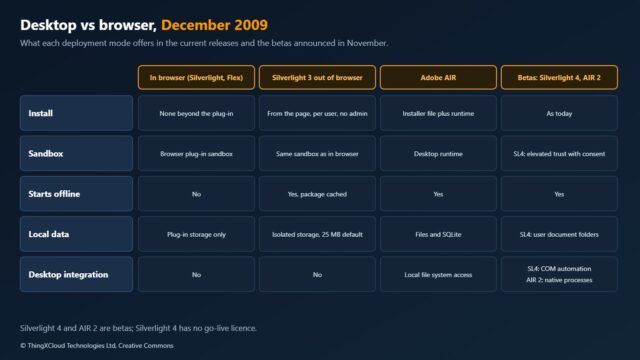
Two deployment modes for rich internet applications: in the browser or installed on the desktop. What Silverlight 3 out of browser, Adobe AIR, and the Silverlight 4 and AIR 2 betas each offer, and how to choose for a line-of-business application.