A FHIR profile is a contract. The International Patient Summary says a patient has a birth date, an allergy names its patient, and a coded element draws its code from a stated value set. A contract that is checked by a person, in a connectathon week or during acceptance testing, is checked late and checked once. The examples in the repository, the fixtures the tests use and the resources a mapper emits drift in between, and the first system to notice is the one on the other side of the interface.
This article puts the check where the drift happens: in the build. Two validators, the HL7 validator and the Firely .NET SDK, check the same resources against the IPS profiles in a GitHub Actions workflow, and a non-conformant resource fails the build. The part that takes most of the design effort is not running a validator. It is knowing that the gate would refuse a broken resource if it saw one, and knowing which kinds of defect it cannot see at all.
The pipeline described here was run in GitHub Actions on 12 November 2026. The section What the pipeline reported records that run, and the listings show the validator and package versions pinned for it. Getting the Firely tool to run changed two details of the design; both are described where they apply.
What the gate has to prove
The requirement sounds like one sentence: fail the build when a resource does not conform. In practice it splits into several, and the non-functional ones decide whether the team keeps the gate switched on.
- Refuse non-conformant resources. Any error-level finding against the declared profile stops the build, with the file, the element path and the message in the log.
- Prove the refusal. The pipeline carries resources that are broken on purpose and fails if any of them passes. A gate that has only ever seen valid input has not been tested.
- Be repeatable. The same commit gives the same verdict next month. That means a pinned validator, pinned packages and no silent dependency on whatever a public server returns today.
- Fail closed. A validator that crashed, wrote no output or validated nothing is a failed build, not a passed one.
- Stay fast enough to run on every push. Package loading dominates the run time, so packages are cached and all files go through one validator start.
- Never touch patient data. Everything validated in CI is synthetic. Build logs and artefacts are not a place for clinical records.
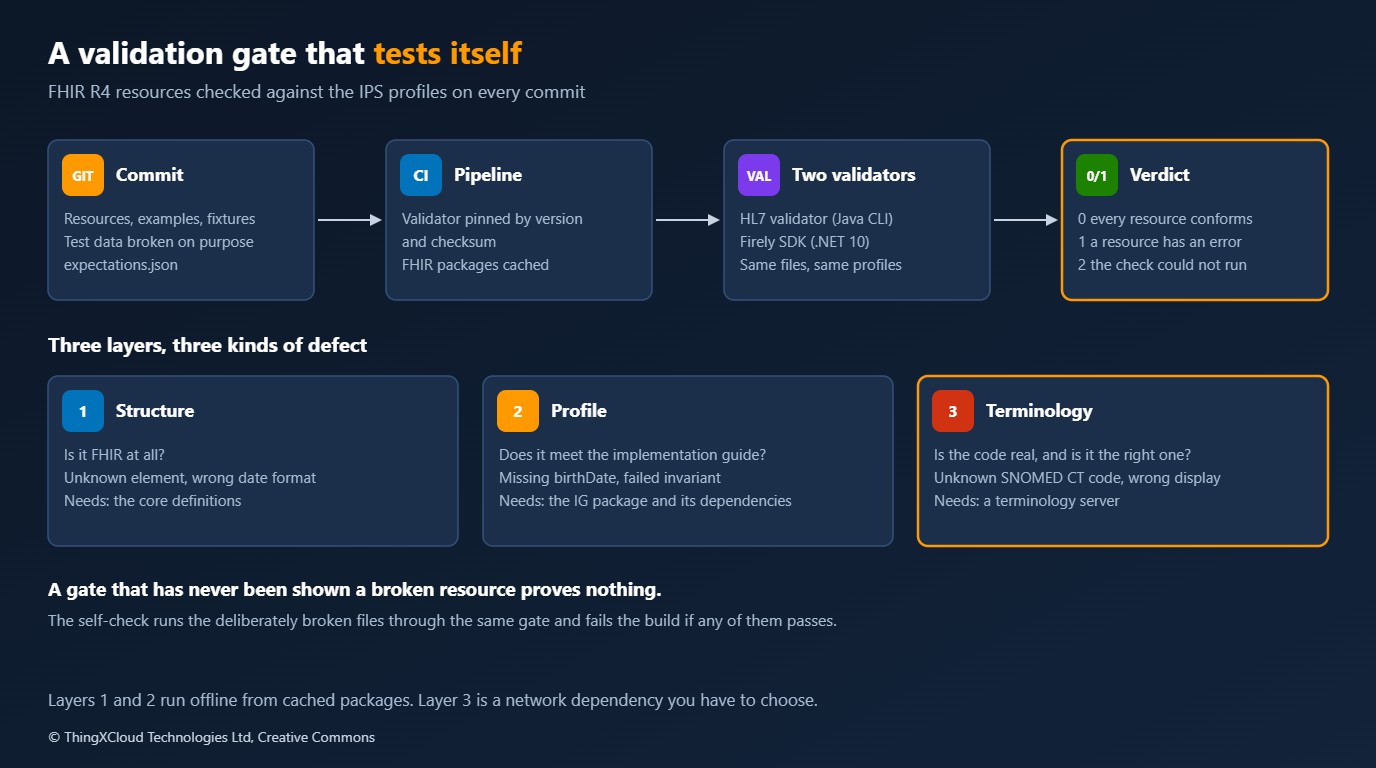
Validation itself has three layers, and they differ in what they need. That difference is the main architectural fact of this article.
| Layer | Question | Example defect | What the validator needs |
|---|---|---|---|
| Structure | Is this FHIR at all? | birthday instead of birthDate; a date written as 12/03/1984 | The core FHIR definitions |
| Profile | Does it meet the implementation guide? | No birthDate on an IPS patient; a name with no family, given or text | The implementation guide package and every package it depends on |
| Terminology | Is the code real, and is it the right code? | A SNOMED CT code that does not exist; a display that belongs to another concept | A terminology server that holds the code system |
Pipeline design
The workflow has one job. It prepares the tools, runs the self-check twice with the HL7 validator (without and with a terminology server), runs the gate the way a product build would, repeats the self-check with the Firely tool, and publishes every output file before deciding the result.
%%{init: {'theme':'base','themeVariables':{'primaryColor':'#FFF3E0','primaryTextColor':'#232F3E','primaryBorderColor':'#FF9900','lineColor':'#232F3E','clusterBkg':'#F8FAFC','clusterBorder':'#CBD5E1','edgeLabelBackground':'#FFFFFF','nodeTextColor':'#232F3E'}}}%%
flowchart TD
    A[Push to the repository] --> B[Set up Java, .NET and Python]
    B --> C[Restore FHIR package cache]
    C --> D[Download pinned validator and verify checksum]
    D --> E[Self-check: HL7 validator, no terminology server]
    E --> F[Self-check: HL7 validator with terminology server]
    F --> G[Gate: conformant folder must exit 0]
    G --> H[Gate: broken folder must exit 1]
    H --> I[Build and run the Firely tool, self-check its findings]
    I --> J[Publish all reports]
    J --> K{Every check as expected?}
    K -->|Yes| L[Build passes]
    K -->|No| M[Build fails]
    classDef compute fill:#FFF3E0,stroke:#FF9900,stroke-width:2px,color:#232F3E
    classDef store fill:#F0FFF4,stroke:#1D8102,stroke-width:2px,color:#145202
    classDef danger fill:#FEF2F2,stroke:#D13212,stroke-width:2px,color:#991B1B
    classDef net fill:#EBF8FF,stroke:#0073BB,stroke-width:2px,color:#004C74
    class A,B,D,E,G,H,I,K compute
    class C,J,L store
    class F net
    class M danger
Each check step is allowed to fail without stopping the job, and a final step turns any failure into a failed build. The order matters: when a gate fails, the reports are what you need, so they are published first.
Test data that is wrong on purpose
The test data is eleven small resources and one file that says what the gate must conclude about each. Two conform. Seven are broken in exactly one way that a validator can see from the definitions alone. Two can only be judged by a terminology server.
| File | Defect | Layer | Expected |
|---|---|---|---|
valid/patient-ok.json | None | Pass | |
valid/allergy-ok.json | None | Pass | |
invalid/patient-unknown-element.json | birthday is not an element of Patient | Structure | Fail |
invalid/patient-bad-date.json | birthDate is not a FHIR date | Structure | Fail |
invalid/patient-bad-gender.json | F is not in the required value set | Structure | Fail |
invalid/allergy-no-patient.json | The mandatory patient reference is absent | Structure | Fail |
invalid/allergy-bad-status.json | ongoing is not a clinical status code | Structure | Fail |
invalid/patient-no-birthdate.json | IPS requires birthDate | Profile | Fail |
invalid/patient-empty-name.json | IPS invariant ips-pat-1: a name needs family, given or text | Profile | Fail |
terminology/allergy-bogus-snomed.json | SNOMED CT code 999999999999 does not exist | Terminology | Fail, with a terminology server |
terminology/allergy-wrong-display.json | The code is an allergy to penicillin, the display says fracture of femur | Terminology | Fail, with a terminology server |
The last file is the one worth looking at. It is well-formed, it meets the profile, the code exists, and it is clinically wrong:
{
  "resourceType": "AllergyIntolerance",
  "id": "ips-allergy-wrong-display",
  "meta": {
    "profile": [
      "http://hl7.org/fhir/uv/ips/StructureDefinition/AllergyIntolerance-uv-ips"
    ]
  },
  "clinicalStatus": {
    "coding": [
      {
        "system": "http://terminology.hl7.org/CodeSystem/allergyintolerance-clinical",
        "code": "active"
      }
    ]
  },
  "code": {
    "coding": [
      {
        "system": "http://snomed.info/sct",
        "code": "91936005",
        "display": "Fracture of femur"
      }
    ]
  },
  "patient": {
    "reference": "Patient/ips-patient-ok"
  }
}
The self-check reads the expectations, runs the gate and gives each case one of four labels: as expected, WRONG, blind spot (a terminology case that passed because no terminology server was in use) and caught anyway. Any WRONG fails the build. Blind spots are counted and printed, because a number in the log is harder to forget than a caveat in a wiki.
If the validator cannot load a profile, every resource that declares it has an error. All the broken test files are then refused, for the wrong reason, and only the conformant ones show the fault. Keep valid resources in the self-check. They are the cases that tell you the gate can still say yes.
The HL7 validator behind a Python wrapper
The HL7 validator is the reference implementation: a Java command-line tool, validator_cli.jar, that loads the core definitions and any implementation guide packages, validates the files it is given and writes its findings as OperationOutcome resources. The wrapper adds the parts a build needs: one validator start for all files, a verdict per file, expectations, and exit codes with a fixed meaning.
"""A validation gate for FHIR resources in a build pipeline.

Two commands:

  gate       Validate every resource under a directory. Exit 1 if any has an error. This is the build step.
  selfcheck  Validate the deliberately broken resources in testdata/ and check that each one is rejected, and
             that the valid ones pass. Exit 1 if the gate lets something through. This tests the gate itself.

Two engines produce the findings: the HL7 validator (a Java command-line tool, run from here) and a small
Firely SDK tool (run separately; its JSON output is read from --firely-results).

    python fhir_gate.py selfcheck --engine hl7 --jar validator_cli.jar --ig hl7.fhir.uv.ips#2.0.0 --tx n/a
    python fhir_gate.py gate --dir resources --engine hl7 --jar validator_cli.jar --ig hl7.fhir.uv.ips#2.0.0
"""
from __future__ import annotations

import argparse
import json
import pathlib
import subprocess
import sys
import time

FILE_EXTENSION = "http://hl7.org/fhir/StructureDefinition/operationoutcome-file"
BLOCKING = {"fatal", "error"}


def run_hl7_validator(jar: str, files: list[pathlib.Path], ig: list[str], tx: str | None, work: pathlib.Path,
                      java: str = "java", timeout: int = 1800) -> dict[str, list[dict]]:
    """Run the HL7 validator once over all files and return {file name: [issue, ...]}."""
    work.mkdir(parents=True, exist_ok=True)
    output = work / "hl7-output.json"
    command = [java, "-jar", jar, *[str(f) for f in files], "-version", "4.0.1", "-output", str(output)]
    for package in ig:
        command += ["-ig", package]
    if tx:
        command += ["-tx", tx]
    started = time.monotonic()
    completed = subprocess.run(command, capture_output=True, text=True, timeout=timeout)
    (work / "hl7-console.txt").write_text(
        f"$ {' '.join(command)}\nexit code {completed.returncode}, {time.monotonic() - started:.0f} s\n\n"
        f"{completed.stdout}\n{completed.stderr}", encoding="utf-8")
    if not output.exists():
        raise RuntimeError(f"The validator wrote no output (exit code {completed.returncode}). See {work / 'hl7-console.txt'}")
    return outcomes_by_file(json.loads(output.read_text(encoding="utf-8")), files)


def outcomes_by_file(document: dict, files: list[pathlib.Path]) -> dict[str, list[dict]]:
    """The validator writes one OperationOutcome for a single file and a Bundle of them for several."""
    outcomes = [document] if document.get("resourceType") == "OperationOutcome" else \
        [entry["resource"] for entry in document.get("entry", [])]
    by_name = {f.name: f for f in files}
    result: dict[str, list[dict]] = {}
    for index, outcome in enumerate(outcomes):
        named = next((e.get("valueString") for e in outcome.get("extension", []) if e.get("url") == FILE_EXTENSION), None)
        name = pathlib.Path(named).name if named else (files[index].name if index < len(files) else f"unknown-{index}")
        if name not in by_name:
            raise RuntimeError(f"The validator reported on '{named}', which is not one of the input files")
        result[name] = [{
            "severity": issue.get("severity", "error"),
            "code": issue.get("code", ""),
            "message": issue.get("details", {}).get("text") or issue.get("diagnostics", ""),
            "location": "; ".join(issue.get("expression", []) or issue.get("location", [])),
        } for issue in outcome.get("issue", [])]
    missing = set(by_name) - set(result)
    if missing:
        raise RuntimeError(f"The validator returned nothing for: {', '.join(sorted(missing))}")
    return result


def load_firely_results(path: str) -> dict[str, list[dict]]:
    return {pathlib.Path(name).name: issues for name, issues in json.loads(pathlib.Path(path).read_text(encoding="utf-8")).items()}


def errors(issues: list[dict]) -> list[dict]:
    return [i for i in issues if i["severity"] in BLOCKING]


def command_gate(args: argparse.Namespace) -> int:
    files = sorted(pathlib.Path(args.dir).rglob("*.json"))
    if not files:
        print(f"No resources under {args.dir}: refusing to pass an empty check")
        return 1
    findings = findings_for(args, files)
    failed = 0
    for file in files:
        blocking = errors(findings[file.name])
        failed += bool(blocking)
        print(f"{'FAIL' if blocking else 'ok  '}  {file}")
        for issue in blocking:
            print(f"        {issue['location'] or '-'}: {issue['message']}")
    print(f"\n{len(files) - failed} of {len(files)} resources conform")
    return 1 if failed else 0


def command_selfcheck(args: argparse.Namespace) -> int:
    root = pathlib.Path(args.testdata)
    cases = json.loads((root / "expectations.json").read_text(encoding="utf-8"))["cases"]
    files = [root / case["file"] for case in cases]
    findings = findings_for(args, files)
    terminology_on = args.engine == "hl7" and bool(args.tx) and args.tx.lower() != "n/a" or \
        (args.engine == "firely" and args.firely_terminology)
    rows, wrong = [], 0
    for case, file in zip(cases, files):
        blocking = errors(findings[file.name])
        verdict = "fail" if blocking else "pass"
        needs_terminology = case.get("needs") == "terminology-server"
        if needs_terminology and not terminology_on:
            status = "blind spot" if verdict == "pass" else "caught anyway"
        else:
            status = "as expected" if verdict == case["expect"] else "WRONG"
            wrong += status == "WRONG"
        rows.append({"file": case["file"], "expected": case["expect"], "verdict": verdict, "status": status,
                     "because": case.get("because", ""), "errors": [f"{i['location']}: {i['message']}"[:300] for i in blocking]})
        print(f"{status:<13} {verdict:<5} {case['file']}")
        for issue in blocking[:3]:
            print(f"              {issue['message'][:160]}")
    summary = {"engine": args.engine, "terminology": "on" if terminology_on else "off", "cases": len(rows), "wrong": wrong,
               "blindSpots": sum(r["status"] == "blind spot" for r in rows), "rows": rows}
    if args.report:
        pathlib.Path(args.report).write_text(json.dumps(summary, indent=2), encoding="utf-8")
    print(f"\n{len(rows) - wrong} of {len(rows)} cases as expected, {summary['blindSpots']} blind spot(s) without a terminology server")
    return 1 if wrong else 0


def findings_for(args: argparse.Namespace, files: list[pathlib.Path]) -> dict[str, list[dict]]:
    if args.engine == "firely":
        return load_firely_results(args.firely_results)
    return run_hl7_validator(args.jar, files, args.ig, args.tx, pathlib.Path(args.work))


def main() -> int:
    parser = argparse.ArgumentParser(description=__doc__, formatter_class=argparse.RawDescriptionHelpFormatter)
    commands = parser.add_subparsers(dest="command", required=True)
    for name in ("gate", "selfcheck"):
        sub = commands.add_parser(name)
        sub.add_argument("--engine", choices=["hl7", "firely"], default="hl7")
        sub.add_argument("--jar", default="validator_cli.jar")
        sub.add_argument("--ig", action="append", default=[], help="implementation guide package, for example hl7.fhir.uv.ips#2.0.0")
        sub.add_argument("--tx", help="terminology server URL, or n/a to validate without one")
        sub.add_argument("--work", default="out")
        sub.add_argument("--firely-results", help="JSON written by the FhirGate tool")
        sub.add_argument("--firely-terminology", action="store_true", help="the Firely run used a terminology server")
        sub.add_argument("--report", help="write the self-check result here as JSON")
    commands.choices["gate"].add_argument("--dir", required=True)
    commands.choices["selfcheck"].add_argument("--testdata", default="testdata")
    args = parser.parse_args()
    try:
        return command_gate(args) if args.command == "gate" else command_selfcheck(args)
    except (RuntimeError, subprocess.TimeoutExpired, OSError, json.JSONDecodeError) as error:
        print(f"The check could not run: {error}")
        return 2


if __name__ == "__main__":
    sys.exit(main())
Four decisions in that file are worth defending.
- The verdict comes from the output file, not the process. The wrapper asks for
-output, reads the Bundle of OperationOutcomes and countserrorandfatalissues per file. It does not rely on the exit code of the Java process to say whether resources were valid. - One start, many files. Loading the core definitions and the IPS package costs far more than validating a small resource. Starting the JVM once per file multiplies that cost by the number of files.
- Every input must be accounted for. The validator names the file each outcome belongs to in an extension. If an outcome names a file that was not submitted, or a submitted file has no outcome, the check stops with exit code 2.
- An empty folder is a failure. A glob that matches nothing after a directory rename would otherwise turn the gate into a step that always passes.
Warnings do not fail the build. That is a policy choice, and a team that wants best-practice warnings to block can add them to BLOCKING. Start with errors: a gate that fails on advice gets switched off.
The same check on the Firely SDK
A .NET team may not want a JVM in the build, and may want the same validation inside its own tests or services. The Firely SDK provides a validator as a library. This console tool on .NET 10 validates each file against the profile it declares in meta.profile and writes findings in the shape the Python self-check reads, so both engines are judged against the same expectations.
using System.Text.Json;
using Firely.Fhir.Packages;
using Firely.Fhir.Validation;
using Hl7.Fhir.Model;
using Hl7.Fhir.Serialization;
using Hl7.Fhir.Specification;
using Hl7.Fhir.Specification.Source;
using Hl7.Fhir.Specification.Terminology;

// Usage: FhirGate --package hl7.fhir.uv.ips@2.0.0 [--package <dependency>@<version>] --out firely.json <file.json> ...
// Validates each resource against the profile it declares in meta.profile, with the Firely .NET SDK, and
// writes {file: [{severity, code, message, location}]} in the shape fhir_gate.py reads.
// Exit code: 0 when the run completed (whatever it found), 2 when it could not run.

List<string> packages = [], files = [];
string output = "firely.json";
for (int i = 0; i < args.Length; i++)
{
    switch (args[i])
    {
        case "--package": packages.Add(args[++i]); break;
        case "--out": output = args[++i]; break;
        default: files.Add(args[i]); break;
    }
}

if (files.Count == 0)
{
    Console.Error.WriteLine("No files given.");
    return 2;
}

const string PackageServer = "https://packages.simplifier.net";
try
{
    // Core definitions plus the implementation guides, resolved from the package server and cached on disk.
    // The source loads exactly the packages it is given: an implementation guide's own dependencies have to
    // be listed too, or its profiles fail to load.
    FhirPackageSource core = FhirPackageSource.CreateCorePackageSource(ModelInfo.ModelInspector, FhirRelease.R4, PackageServer);
    FhirPackageSource guides = new(ModelInfo.ModelInspector, PackageServer, [.. packages]);
    CachedResolver resolver = new(new MultiResolver(guides, core));

    // Value sets that can be expanded from the packages are checked locally. Codes from large external code
    // systems such as SNOMED CT are not: that takes a terminology server.
    LocalTerminologyService terminology = new(resolver);
    Validator validator = new(resolver, terminology);
    FhirJsonParser parser = new();

    Dictionary<string, List<Finding>> results = [];
    foreach (string file in files)
    {
        List<Finding> findings = [];
        results[Path.GetFileName(file)] = findings;
        Resource resource;
        try
        {
            resource = parser.Parse<Resource>(await File.ReadAllTextAsync(file));
        }
        catch (Exception ex) when (ex is FormatException or DeserializationFailedException or InvalidOperationException)
        {
            // Content that is not valid FHIR at all never reaches profile validation.
            findings.Add(new Finding("error", "structure", ex.Message, ""));
            continue;
        }

        string? profile = resource.Meta?.Profile?.FirstOrDefault();
        OperationOutcome outcome = profile is null ? validator.Validate(resource) : validator.Validate(resource, profile);
        findings.AddRange(outcome.Issue.Select(issue => new Finding(
            issue.Severity?.ToString().ToLowerInvariant() ?? "error",
            issue.Code?.ToString() ?? "",
            issue.Details?.Text ?? issue.Diagnostics ?? "",
            string.Join("; ", issue.Expression ?? []))));
    }

    await File.WriteAllTextAsync(output, JsonSerializer.Serialize(results, new JsonSerializerOptions { WriteIndented = true, PropertyNamingPolicy = JsonNamingPolicy.CamelCase }));
    foreach ((string file, List<Finding> findings) in results)
    {
        int errors = findings.Count(f => f.Severity is "error" or "fatal");
        Console.WriteLine($"{(errors == 0 ? "ok  " : "FAIL")}  {file}  ({errors} error(s), {findings.Count - errors} other)");
    }

    return 0;
}
catch (Exception ex)
{
    Console.Error.WriteLine($"The validation run could not complete: {ex.GetType().Name}: {ex.Message}");
    return 2;
}

internal sealed record Finding(string Severity, string Code, string Message, string Location);
<Project Sdk="Microsoft.NET.Sdk">
<PropertyGroup>
<OutputType>Exe</OutputType>
<TargetFramework>net10.0</TargetFramework>
<Nullable>enable</Nullable>
<ImplicitUsings>enable</ImplicitUsings>
</PropertyGroup>
<ItemGroup>
<PackageReference Include="Firely.Fhir.Validation.R4" Version="3.6.0" />
<PackageReference Include="Firely.Fhir.Packages" Version="5.0.2" />
</ItemGroup>
</Project>Three things differ from the HL7 validator, and each one can catch you out.
- Package dependencies are yours to list. The package source loads the packages it is given. IPS profiles refer to extensions published in a separate package,
hl7.fhir.uv.extensions.r4; with only the IPS package listed, the IPS Patient profile does not load. The workflow passes the dependency as a second--package. The HL7 validator resolves dependencies itself. - Parsing comes first. A resource with an unknown element or a malformed date fails in the parser before profile validation starts. The tool reports that as a structure error so the file still gets a verdict.
- Terminology is local unless you say otherwise.
LocalTerminologyServicechecks codes against value sets it can expand from the loaded packages. It has no SNOMED CT. The SDK can call an external terminology server as well; that configuration is not part of this sample.
The package library has to belong to the same SDK generation as the validator. Both references are pinned in the project file for that reason.
The workflow
name: FHIR validation gate

on:
  push:
    paths:
      - "fhir-validation-ci/**"
      - ".github/workflows/fhir-validation.yml"
  workflow_dispatch:

permissions:
  contents: write   # only to publish the result files to the ci-results branch

concurrency:
  group: fhir-validation-${{ github.ref }}
  cancel-in-progress: true

jobs:
  validate:
    runs-on: ubuntu-latest
    timeout-minutes: 30
    defaults:
      run:
        working-directory: fhir-validation-ci
    env:
      # Pinned, with a checksum. An unpinned validator changes what "valid" means between two builds.
      VALIDATOR_VERSION: "7.0.5"
      VALIDATOR_SHA256: 9dfe9f305b0f9389eceade2a4a1c9a2740d7b0e614066fdf07a78b571c76d92f
      IPS_PACKAGE_HL7: hl7.fhir.uv.ips#2.0.0
      IPS_PACKAGE_FIRELY: hl7.fhir.uv.ips@2.0.0
      # The Firely package source loads what it is given: the packages IPS depends on are listed explicitly.
      IPS_DEPENDENCIES_FIRELY: hl7.fhir.uv.extensions.r4@5.3.0-ballot-tc1
    steps:
      - uses: actions/checkout@v4
      - uses: actions/setup-java@v4
        with:
          distribution: temurin
          java-version: "21"
      - uses: actions/setup-dotnet@v4
        with:
          dotnet-version: "10.0.x"
      - uses: actions/setup-python@v5
        with:
          python-version: "3.13"

      # FHIR packages are downloaded once and reused. Without the cache every run depends on the registry.
      - uses: actions/cache@v4
        with:
          path: ~/.fhir/packages
          key: fhir-packages-${{ hashFiles('.github/workflows/fhir-validation.yml') }}

      - name: Download the HL7 validator
        run: |
          mkdir -p out
          curl -fsSL -o validator_cli.jar "https://github.com/hapifhir/org.hl7.fhir.core/releases/download/${VALIDATOR_VERSION}/validator_cli.jar"
          echo "${VALIDATOR_SHA256}  validator_cli.jar" | sha256sum --check | tee out/validator-jar.txt

      - name: Self-check, HL7 validator without a terminology server
        id: hl7_notx
        continue-on-error: true
        run: python gate/fhir_gate.py selfcheck --engine hl7 --ig "$IPS_PACKAGE_HL7" --tx n/a --work out/hl7-notx --report out/hl7-notx/report.json | tee out/hl7-notx.txt

      - name: Self-check, HL7 validator with tx.fhir.org
        id: hl7_tx
        continue-on-error: true
        run: python gate/fhir_gate.py selfcheck --engine hl7 --ig "$IPS_PACKAGE_HL7" --tx https://tx.fhir.org --work out/hl7-tx --report out/hl7-tx/report.json | tee out/hl7-tx.txt

      # The build step itself: conformant resources pass, and one non-conformant resource fails the step.
      - name: Gate, conformant resources pass
        id: gate_valid
        continue-on-error: true
        run: python gate/fhir_gate.py gate --dir testdata/valid --engine hl7 --ig "$IPS_PACKAGE_HL7" --tx n/a --work out/gate-valid | tee out/gate-valid.txt

      - name: Gate, non-conformant resources are refused
        id: gate_invalid
        continue-on-error: true
        run: |
          set +e
          python gate/fhir_gate.py gate --dir testdata/invalid --engine hl7 --ig "$IPS_PACKAGE_HL7" --tx n/a --work out/gate-invalid > out/gate-invalid.txt
          code=$?
          echo "exit code $code" | tee -a out/gate-invalid.txt
          test "$code" -eq 1

      - name: Build the Firely tool
        id: firely_build
        continue-on-error: true
        run: |
          set -o pipefail
          dotnet build firely/FhirGate/FhirGate.csproj -c Release -o out/firely-bin 2>&1 | tee out/firely-build.txt
          dotnet list firely/FhirGate/FhirGate.csproj package --include-transitive > out/firely-packages.txt

      - name: Self-check, Firely SDK
        id: firely
        continue-on-error: true
        run: |
          set -o pipefail
          dotnet out/firely-bin/FhirGate.dll --package "$IPS_PACKAGE_FIRELY" --package "$IPS_DEPENDENCIES_FIRELY" --out out/firely.json testdata/valid/*.json testdata/invalid/*.json testdata/terminology/*.json 2>&1 | tee out/firely-run.txt
          python gate/fhir_gate.py selfcheck --engine firely --firely-results out/firely.json --report out/firely-report.json | tee out/firely.txt

      - name: Publish the results
        if: always()
        env:
          GITHUB_TOKEN: ${{ secrets.GITHUB_TOKEN }}
        run: |
          rm -rf out/firely-bin
          {
            echo "commit: $GITHUB_SHA"
            echo "run: $GITHUB_SERVER_URL/$GITHUB_REPOSITORY/actions/runs/$GITHUB_RUN_ID"
            echo "date: $(date -u +%Y-%m-%dT%H:%M:%SZ)"
            echo "hl7_notx: ${{ steps.hl7_notx.outcome }}"
            echo "hl7_tx: ${{ steps.hl7_tx.outcome }}"
            echo "gate_valid: ${{ steps.gate_valid.outcome }}"
            echo "gate_invalid: ${{ steps.gate_invalid.outcome }}"
            echo "firely_build: ${{ steps.firely_build.outcome }}"
            echo "firely: ${{ steps.firely.outcome }}"
            java -version 2>&1 | head -1
            dotnet --version
          } > out/run.txt
          cat out/run.txt >> "$GITHUB_STEP_SUMMARY"
          publish="$RUNNER_TEMP/publish"
          rm -rf "$publish" && mkdir -p "$publish" && cp -r out/. "$publish/"
          cd "$publish"
          git init -q -b ci-results
          git config user.name "github-actions[bot]"
          git config user.email "41898282+github-actions[bot]@users.noreply.github.com"
          git add -A
          git commit -q -m "Validation results for $GITHUB_SHA"
          git push -f "https://x-access-token:${GITHUB_TOKEN}@github.com/${GITHUB_REPOSITORY}.git" ci-results

      - name: Fail the build if the gate let something through
        if: steps.hl7_notx.outcome != 'success' || steps.hl7_tx.outcome != 'success' || steps.gate_valid.outcome != 'success' || steps.gate_invalid.outcome != 'success' || steps.firely_build.outcome != 'success' || steps.firely.outcome != 'success'
        run: |
          echo "One or more validation checks failed. See the ci-results branch."
          exit 1
The points that carry over to any CI system:
- Pin the validator and verify it. The validator is released often, and each release can change which findings are errors. Downloading the latest release on every run means the meaning of “valid” changes without a commit. The workflow names a version and checks the SHA-256 of the download. Upgrading becomes a pull request that either passes the self-check or shows what changed.
- Cache the FHIR packages. Both tools keep packages in
~/.fhir/packages. Caching that folder removes the package registry from the critical path of most builds. - Collect, publish, then fail. Check steps use
continue-on-errorand a final step fails the job. The reports exist whether the build passed or not. - Least privilege. This sample needs
contents: writeonly because it pushes its reports to a results branch so they can be read without signing in. A product pipeline should upload them as build artefacts and keepcontents: read.
Terminology: the layer that needs a server
Structure and profile checks are computed from definitions that fit in a package. Terminology is different in kind. SNOMED CT has several hundred thousand concepts, is released in editions, and is licensed. Neither validator carries it. When a resource holds a SNOMED CT code, the validator has two options: ask a server, or accept the code unchecked.
%%{init: {'theme':'base','themeVariables':{'primaryColor':'#FFF3E0','primaryTextColor':'#232F3E','primaryBorderColor':'#FF9900','lineColor':'#232F3E','signalColor':'#0073BB','signalTextColor':'#0F172A','actorBkg':'#FFF3E0','actorBorder':'#FF9900','actorTextColor':'#232F3E','noteBkgColor':'#FFF8E7','noteBorderColor':'#FF9900','noteTextColor':'#232F3E'}}}%%
sequenceDiagram
    participant P as Pipeline
    participant V as Validator
    participant T as Terminology server
    P->>V: Validate allergy with SNOMED CT code
    V->>V: Structure and profile checks from packages
    V->>T: Is this code valid, and is this its display?
    T-->>V: Unknown code, or wrong display
    V-->>P: OperationOutcome with error
Note over P,V: Without the server the code is accepted unchecked| Option | What it catches | Advantages | Risks and cost |
|---|---|---|---|
| No terminology server | Codes in value sets that ship in the packages | Offline, fast, fully repeatable | Blind to SNOMED CT, LOINC and other large code systems; a wrong code passes |
Public server, tx.fhir.org | Codes and displays in the code systems it hosts | Nothing to operate | The build depends on a shared public service and on the editions it holds that day; not for confidential content |
| Your own terminology server | The editions and national extensions your programme uses | Repeatable, private, the same content your runtime uses | A service to run, load and upgrade; licensing for SNOMED CT is your organisation’s to hold |
The recommendation that follows from this: run the offline check on every push and treat it as the fast gate. Run the terminology check against a server you control, on pull requests to the main branch or on a schedule, and pin the code system edition there. Use the public server to get started and for open, synthetic content.
A resource can conform to its profile and still say the wrong thing: the test file above codes an allergy to penicillin and displays a fracture. Validation reduces interface defects. It is not evidence of clinical correctness, and it does not replace clinical safety review of mappings. Validate synthetic data only in CI: build logs, caches and artefacts are rarely covered by the controls that apply to patient records, and a terminology request to a public server leaves your network.
What the pipeline reported
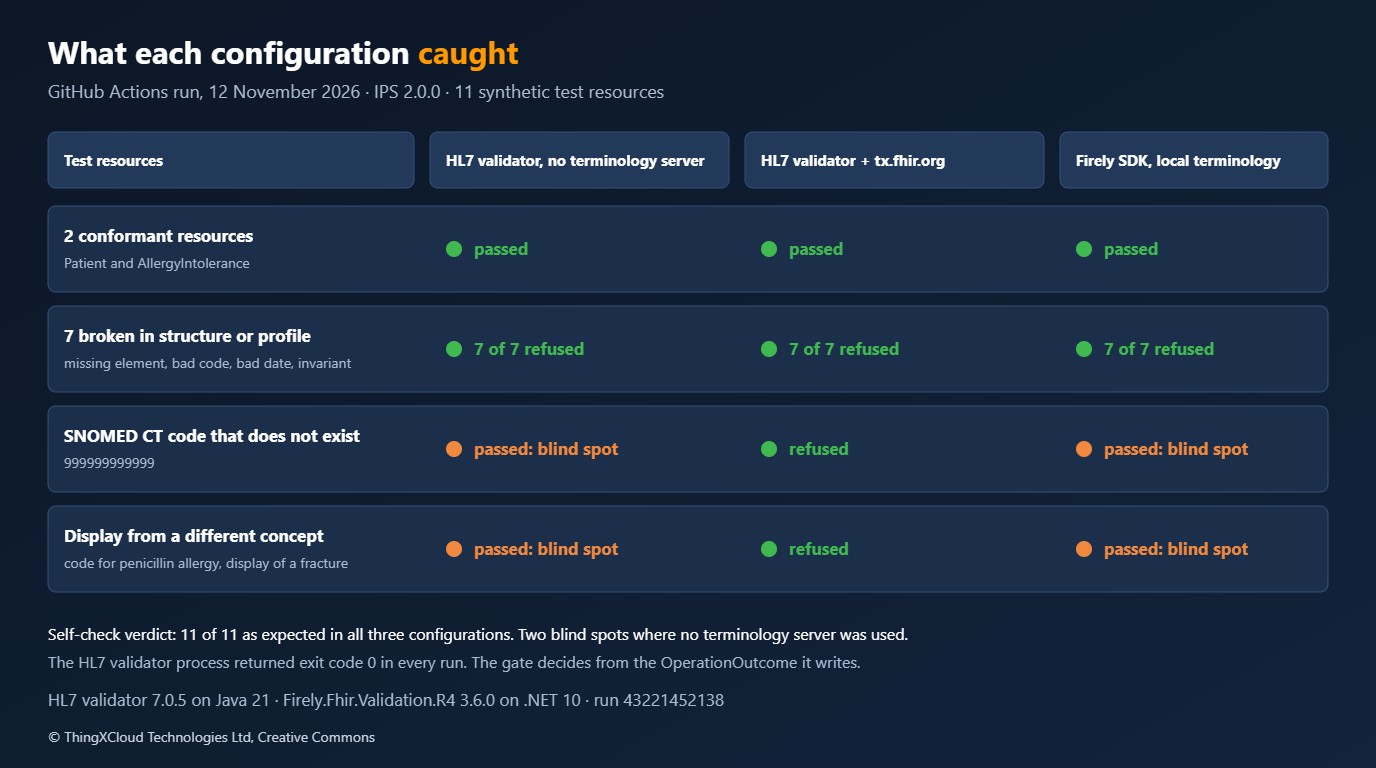
Everything in this section comes from one GitHub Actions run on ubuntu-latest on 12 November 2026: HL7 validator 7.0.5 on Java 21.0.13, Firely.Fhir.Validation.R4 3.6.0 with Hl7.Fhir.R4 6.8.0 and Firely.Fhir.Packages 5.0.2 on .NET SDK 10.0.404, Python 3.13, IPS 2.0.0. The terminology server was the public tx.fhir.org, which answered from the SNOMED CT International Edition of 1 February 2025.
| Check | Result |
|---|---|
| Self-check, HL7 validator, no terminology server | 11 of 11 as expected, 2 blind spots |
Self-check, HL7 validator with tx.fhir.org | 11 of 11 as expected, 0 blind spots |
| Gate on the conformant folder | 2 of 2 conform, exit code 0 |
| Gate on the broken folder | 0 of 7 conform, exit code 1 |
| Self-check, Firely SDK, local terminology | 11 of 11 as expected, 2 blind spots |
The gate step on the broken folder printed this, shortened here to one finding per file:
FAIL  testdata/invalid/allergy-bad-status.json
        AllergyIntolerance.clinicalStatus.coding[0].code: Unknown code 'ongoing' in the CodeSystem 'http://terminology.hl7.org/CodeSystem/allergyintolerance-clinical' version '1.0.1'
FAIL  testdata/invalid/allergy-no-patient.json
        AllergyIntolerance: AllergyIntolerance.patient: minimum required = 1, but only found 0 (from http://hl7.org/fhir/uv/ips/StructureDefinition/AllergyIntolerance-uv-ips|2.0.0)
FAIL  testdata/invalid/patient-bad-date.json
        Patient.birthDate: Not a valid date format: '12/03/1984'
FAIL  testdata/invalid/patient-empty-name.json
        Patient.name[0]: Constraint failed: ips-pat-1: 'Patient.name.given, Patient.name.family or Patient.name.text SHALL be present' (defined in http://hl7.org/fhir/uv/ips/StructureDefinition/Patient-uv-ips)
FAIL  testdata/invalid/patient-no-birthdate.json
        Patient: Patient.birthDate: minimum required = 1, but only found 0 (from http://hl7.org/fhir/uv/ips/StructureDefinition/Patient-uv-ips|2.0.0)
FAIL  testdata/invalid/patient-unknown-element.json
        Patient: Unrecognized property 'birthday'

0 of 7 resources conform
exit code 1
Five observations from the run are worth more than the pass counts.
- The validator process returned 0 every time. In all four invocations, including the one where seven of seven resources had errors, the Java process exited with code 0. A pipeline step that runs the jar and trusts the exit status would have passed that folder. The wrapper’s decision to read the OperationOutcome is what makes it a gate.
- Without a terminology server, wrong SNOMED CT codes pass in both engines. The code that does not exist and the display from another concept were accepted. The HL7 validator reported one narrative best-practice warning for those files and nothing about the code. The Firely tool reported no issue at all.
- With the terminology server, both were refused, with messages a developer can act on:
Unknown code '999999999999' in the CodeSystem 'http://snomed.info/sct'andWrong Display Name 'Fracture of femur' for http://snomed.info/sct#91936005, followed by the valid displays. - The two engines agree on verdicts and differ in wording. For the missing birth date the HL7 validator says
minimum required = 1, but only found 0and names the profile; the Firely tool saysMissing required member: 'birthDate'. Assert on verdicts and element paths in tests, not on message text. - The first Firely runs were wrong in a way that looked right. Before the extensions package was listed, the IPS Patient profile failed to load, every broken patient was “refused”, and the only visible symptom was that the conformant patient failed too. This is the case the warning above describes.
Run time was dominated by loading. The two self-check runs, which started with an empty package cache, took 27 and 23 seconds for eleven files. The two gate steps that followed, with packages on disk, took 12 and 7 seconds. These are single measurements on a shared hosted runner, useful for order of magnitude only.
Choosing a validator
| Option | Advantages | Disadvantages | Operational implications |
|---|---|---|---|
| HL7 validator CLI | Reference implementation; resolves package dependencies itself; the tool most implementation guide authors test with | Needs a JVM; start-up and loading cost on every run; process exit code is not a verdict | Pin and checksum the jar; wrap it; upgrade deliberately |
| Firely SDK in a .NET tool or test project | In-process for .NET teams; the same code can validate in unit tests and at run time; no JVM | You list package dependencies; parser and validator report through different paths; terminology server is extra configuration | NuGet versions pinned together; self-check is essential after every upgrade |
Server-side $validate | Validates with the profiles and terminology the server really has loaded | The build depends on a running server; profile loading becomes an environment concern; slower per resource | Suits integration stages better than every push |
For a build gate the HL7 validator is the default choice, because it is what profile authors and other implementers will run when they dispute your resource. A .NET team gains from running the Firely validator as well, inside its own tests, provided it keeps the self-check. Running both in one pipeline, as this sample does, is a way to learn where they differ; it is not something every product build needs. $validate against the target server belongs later, in integration testing. It was not run for this article.
IPS, European and national profiles
Nothing in the gate is specific to IPS. The profile set is a package coordinate, and the resources declare which profile they claim in meta.profile. To gate on the HL7 Europe base and core profiles, or on a national core, change the -ig argument (and, for the Firely tool, the --package list including dependencies) and add test resources for that guide. Three cautions apply. Ballot versions change between releases, so pin the exact version you have agreed with your partners. National guides often bind to national SNOMED CT extensions, which the public terminology server may not hold. And a resource that claims several profiles has to pass all of them; validate against each one explicitly if your tooling only reads the first. Only IPS 2.0.0 was run here.
Security and operations
- Supply chain. The validator is an executable downloaded into the build. Pin the version, verify the checksum, and mirror it to an internal artefact store if your build network is restricted. The same goes for FHIR packages: a private package feed removes two public registries from the build.
- Secrets. The offline gate needs none. A private terminology server does; give the pipeline a read-only credential scoped to validation operations.
- Observability. Keep the machine-readable report per run. A rising count of warnings, or a change in the number of files validated, is a signal even when the build is green.
- Ownership. Someone has to own the upgrade of validator, packages and code system editions. Put it on a schedule; do not let it happen by accident.
- Scope. Gate what you emit: mapper outputs, examples in your own implementation guide, test fixtures. Validating inbound production traffic is a different design with different latency and privacy constraints.
Cost
The cost of the gate is runner minutes and the time developers wait. Both are driven by loading definitions, not by the number of resources, so the levers are the package cache, one validator start per run and keeping the terminology check off the per-push path. A hosted terminology server is the only component with a standing cost, and most programmes that exchange coded clinical data need one at run time anyway. The larger saving is not on the bill: a conformance defect found in the build costs a commit, and the same defect found by a partner costs a release.
The workflow, the Python wrapper and the Firely tool ran in GitHub Actions on 12 November 2026 (run 43221452138), and the listings are the files in the samples repository. Not run: the HL7 Europe or any national profile set, a private terminology server, the Firely validator with an external terminology server, $validate on a FHIR server, bundles and documents (single resources only), FHIR R5, and any CI system other than GitHub Actions. All test resources are synthetic.
Earlier in this series: migrating from Azure API for FHIR to Azure Health Data Services and FHIR subscriptions and events on Azure.
Key terms
- Profile— A set of constraints on a FHIR resource type, published as a StructureDefinition in an implementation guide.
- IPS— International Patient Summary, an HL7 implementation guide for a minimal, cross-border patient summary.
- Implementation guide package— A versioned archive of profiles, value sets and extensions, identified by a name and version such as
hl7.fhir.uv.ips#2.0.0. - OperationOutcome— The FHIR resource a validator returns: a list of issues, each with a severity, a code, a location and a message.
- Terminology server— A service that answers questions about code systems and value sets, such as whether a code exists and what its display is.
- Invariant— A rule in a profile written as a FHIRPath expression, for example
ips-pat-1.
References & Further Reading
- → Using the FHIR Validator— HL7 documentation for validator_cli.jar and its parameters
- → org.hl7.fhir.core releases— Validator releases and release notes
- → Firely .NET SDK: validating data against profiles— The validator API used by the C# tool
- → Firely .NET SDK: using terminology services— Local and external terminology services
- → International Patient Summary Implementation Guide— The profiles validated in this article
- → HL7 Europe Base and Core FHIR IG— European base and core profiles
- → FHIR R4: Validating Resources— What the specification means by validation, and its layers
- → tx.fhir.org— The public HL7 terminology server
- → Sample code for this article— Test data, the Python gate, the Firely tool and the workflow
Discover more from C4: Container, Code, Cloud & Context
Subscribe to get the latest posts sent to your email.