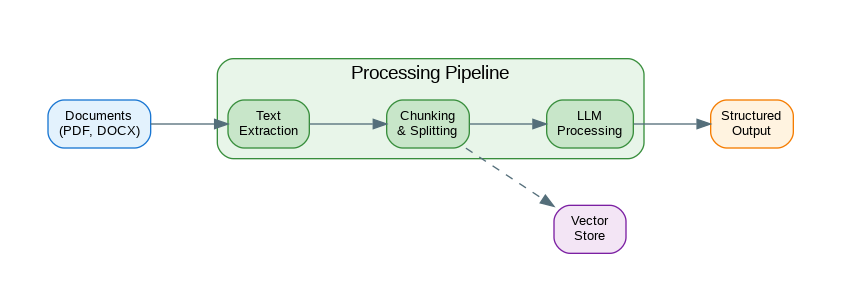
Introduction: Processing documents with LLMs unlocks powerful capabilities: extracting structured data from unstructured text, summarizing lengthy reports, answering questions about document content, and transforming documents between formats. However, effective document processing requires more than just sending text to an LLM—it demands careful parsing, intelligent chunking, and strategic prompting. This guide covers practical document processing patterns: parsing various formats, chunking strategies for context windows, extraction and summarization techniques, and production-ready pipelines for processing documents at scale.
- Part 1: From PDFs to structured data
- Part 2 (this article): Enterprise parsing, chunking, and extraction
Enterprise Document Extraction
Enterprise document processing handles diverse document types at scale. This architecture shows how extraction pipelines handle complex documents.
flowchart TB
    subgraph Intake["Document Intake"]
        S3[S3 Bucket]
        API[Upload API]
        EM[Email Parser]
    end

    subgraph Classification["Classification"]
        DC[Doc Classifier]
        TE[Type Extractor]
    end

    subgraph Extraction["Extraction Pipelines"]
        INV[Invoice Pipeline]
        CON[Contract Pipeline]
        RES[Resume Pipeline]
    end

    subgraph Validation["Validation"]
        SV[Schema Validator]
        BC[Business Rules]
        HV[Human Review]
    end

    subgraph Output["Output"]
        DB[(Database)]
        WF[Workflow]
    end

    S3 --> DC
    API --> DC
    EM --> DC
    DC --> TE
    TE --> INV
    TE --> CON
    TE --> RES
    INV --> SV
    CON --> SV
    RES --> SV
    SV --> BC
    BC -->|Pass| DB
    BC -->|Fail| HV
    HV --> DB
    DB --> WF

    style S3 fill:#E3F2FD,stroke:#90CAF9,stroke-width:2px,color:#1565C0
    style API fill:#E3F2FD,stroke:#90CAF9,stroke-width:2px,color:#1565C0
    style EM fill:#E3F2FD,stroke:#90CAF9,stroke-width:2px,color:#1565C0
    style DC fill:#F3E5F5,stroke:#CE93D8,stroke-width:2px,color:#6A1B9A
    style TE fill:#F3E5F5,stroke:#CE93D8,stroke-width:2px,color:#6A1B9A
    style INV fill:#E8F5E9,stroke:#A5D6A7,stroke-width:2px,color:#2E7D32
    style CON fill:#E8F5E9,stroke:#A5D6A7,stroke-width:2px,color:#2E7D32
    style RES fill:#E8F5E9,stroke:#A5D6A7,stroke-width:2px,color:#2E7D32
    style SV fill:#FFF3E0,stroke:#FFCC80,stroke-width:2px,color:#E65100
    style BC fill:#FFF3E0,stroke:#FFCC80,stroke-width:2px,color:#E65100
    style HV fill:#FCE4EC,stroke:#F48FB1,stroke-width:2px,color:#AD1457
    style DB fill:#ECEFF1,stroke:#90A4AE,stroke-width:2px,color:#455A64
    style WF fill:#ECEFF1,stroke:#90A4AE,stroke-width:2px,color:#455A64
Figure 1: Enterprise Document Extraction Architecture
Document Parsing
The following code implements document parsing. Key aspects include proper error handling and clean separation of concerns.
from dataclasses import dataclass, field
from typing import Any, Optional
from enum import Enum
from pathlib import Path

class DocumentType(Enum):
    PDF = "pdf"
    DOCX = "docx"
    HTML = "html"
    MARKDOWN = "markdown"
    TXT = "txt"
    CSV = "csv"

@dataclass
class ParsedDocument:
    """A parsed document with extracted content."""

    content: str
    doc_type: DocumentType
    metadata: dict = field(default_factory=dict)
    pages: list[str] = field(default_factory=list)
    tables: list[dict] = field(default_factory=list)
    images: list[dict] = field(default_factory=list)

class DocumentParser:
    """Parse various document formats."""

    def parse(self, file_path: str) -> ParsedDocument:
        """Parse document based on file extension."""

        path = Path(file_path)
        extension = path.suffix.lower()

        parsers = {
            ".pdf": self._parse_pdf,
            ".docx": self._parse_docx,
            ".html": self._parse_html,
            ".htm": self._parse_html,
            ".md": self._parse_markdown,
            ".txt": self._parse_text,
            ".csv": self._parse_csv,
        }

        parser = parsers.get(extension)
        if not parser:
            raise ValueError(f"Unsupported file type: {extension}")

        return parser(file_path)

    def _parse_pdf(self, file_path: str) -> ParsedDocument:
        """Parse PDF document."""

        import fitz  # PyMuPDF

        doc = fitz.open(file_path)
        pages = []
        tables = []
        images = []

        for page_num, page in enumerate(doc):
            # Extract text
            text = page.get_text()
            pages.append(text)

            # Extract images
            for img_index, img in enumerate(page.get_images()):
                images.append({
                    "page": page_num,
                    "index": img_index,
                    "xref": img[0]
                })

        return ParsedDocument(
            content="\n\n".join(pages),
            doc_type=DocumentType.PDF,
            metadata={
                "page_count": len(pages),
                "title": doc.metadata.get("title", ""),
                "author": doc.metadata.get("author", "")
            },
            pages=pages,
            images=images
        )

    def _parse_docx(self, file_path: str) -> ParsedDocument:
        """Parse Word document."""

        from docx import Document

        doc = Document(file_path)

        paragraphs = []
        tables = []

        for para in doc.paragraphs:
            if para.text.strip():
                paragraphs.append(para.text)

        for table in doc.tables:
            table_data = []
            for row in table.rows:
                row_data = [cell.text for cell in row.cells]
                table_data.append(row_data)
            tables.append({"data": table_data})

        return ParsedDocument(
            content="\n\n".join(paragraphs),
            doc_type=DocumentType.DOCX,
            metadata={"paragraph_count": len(paragraphs)},
            tables=tables
        )

    def _parse_html(self, file_path: str) -> ParsedDocument:
        """Parse HTML document."""

        from bs4 import BeautifulSoup

        with open(file_path, 'r', encoding='utf-8') as f:
            soup = BeautifulSoup(f.read(), 'html.parser')

        # Remove script and style elements
        for element in soup(['script', 'style', 'nav', 'footer']):
            element.decompose()

        text = soup.get_text(separator='\n', strip=True)

        # Extract tables
        tables = []
        for table in soup.find_all('table'):
            rows = []
            for row in table.find_all('tr'):
                cells = [cell.get_text(strip=True) for cell in row.find_all(['td', 'th'])]
                rows.append(cells)
            tables.append({"data": rows})

        return ParsedDocument(
            content=text,
            doc_type=DocumentType.HTML,
            metadata={"title": soup.title.string if soup.title else ""},
            tables=tables
        )

    def _parse_markdown(self, file_path: str) -> ParsedDocument:
        """Parse Markdown document."""

        with open(file_path, 'r', encoding='utf-8') as f:
            content = f.read()

        return ParsedDocument(
            content=content,
            doc_type=DocumentType.MARKDOWN,
            metadata={}
        )

    def _parse_text(self, file_path: str) -> ParsedDocument:
        """Parse plain text document."""

        with open(file_path, 'r', encoding='utf-8') as f:
            content = f.read()

        return ParsedDocument(
            content=content,
            doc_type=DocumentType.TXT,
            metadata={}
        )

    def _parse_csv(self, file_path: str) -> ParsedDocument:
        """Parse CSV document."""

        import csv

        with open(file_path, 'r', encoding='utf-8') as f:
            reader = csv.reader(f)
            rows = list(reader)

        # Convert to text representation
        text_rows = [", ".join(row) for row in rows]

        return ParsedDocument(
            content="\n".join(text_rows),
            doc_type=DocumentType.CSV,
            metadata={"row_count": len(rows)},
            tables=[{"data": rows}]
        )
Chunking Strategies
Chunking splits documents into manageable pieces while preserving context. The strategy you choose significantly impacts retrieval quality.
from dataclasses import dataclass
from typing import Callable, Optional
import re

@dataclass
class Chunk:
    """A chunk of document content."""

    content: str
    index: int
    metadata: dict = None

    @property
    def token_estimate(self) -> int:
        """Rough token estimate (4 chars per token)."""
        return len(self.content) // 4

class TextChunker:
    """Split text into chunks."""

    def __init__(
        self,
        chunk_size: int = 1000,
        chunk_overlap: int = 200,
        length_function: Callable[[str], int] = None
    ):
        self.chunk_size = chunk_size
        self.chunk_overlap = chunk_overlap
        self.length_function = length_function or len

    def chunk(self, text: str) -> list[Chunk]:
        """Split text into overlapping chunks."""

        chunks = []
        start = 0
        index = 0

        while start < len(text):
            end = start + self.chunk_size

            # Find a good break point
            if end < len(text):
                # Try to break at paragraph
                break_point = text.rfind('\n\n', start, end)
                if break_point == -1:
                    # Try sentence break
                    break_point = text.rfind('. ', start, end)
                if break_point == -1:
                    # Try word break
                    break_point = text.rfind(' ', start, end)
                if break_point > start:
                    end = break_point + 1

            chunk_text = text[start:end].strip()

            if chunk_text:
                chunks.append(Chunk(
                    content=chunk_text,
                    index=index,
                    metadata={"start": start, "end": end}
                ))
                index += 1

            start = end - self.chunk_overlap

        return chunks

class SemanticChunker:
    """Chunk based on semantic boundaries."""

    def __init__(
        self,
        max_chunk_size: int = 1000,
        min_chunk_size: int = 100
    ):
        self.max_chunk_size = max_chunk_size
        self.min_chunk_size = min_chunk_size

    def chunk(self, text: str) -> list[Chunk]:
        """Split at semantic boundaries."""

        # Split by headers and sections
        sections = self._split_by_headers(text)

        chunks = []
        index = 0

        for section in sections:
            if len(section) <= self.max_chunk_size:
                if len(section) >= self.min_chunk_size:
                    chunks.append(Chunk(content=section, index=index))
                    index += 1
            else:
                # Further split large sections
                sub_chunks = self._split_by_paragraphs(section)
                for sub in sub_chunks:
                    chunks.append(Chunk(content=sub, index=index))
                    index += 1

        return chunks

    def _split_by_headers(self, text: str) -> list[str]:
        """Split text by markdown-style headers."""

        # Match headers (# Header, ## Header, etc.)
        pattern = r'(?=^#{1,6}\s)'
        sections = re.split(pattern, text, flags=re.MULTILINE)

        return [s.strip() for s in sections if s.strip()]

    def _split_by_paragraphs(self, text: str) -> list[str]:
        """Split text by paragraphs, respecting max size."""

        paragraphs = text.split('\n\n')
        chunks = []
        current_chunk = ""

        for para in paragraphs:
            if len(current_chunk) + len(para) <= self.max_chunk_size:
                current_chunk += para + "\n\n"
            else:
                if current_chunk:
                    chunks.append(current_chunk.strip())
                current_chunk = para + "\n\n"

        if current_chunk:
            chunks.append(current_chunk.strip())

        return chunks

class RecursiveChunker:
    """Recursively split using multiple separators."""

    SEPARATORS = ["\n\n", "\n", ". ", " ", ""]

    def __init__(
        self,
        chunk_size: int = 1000,
        chunk_overlap: int = 200
    ):
        self.chunk_size = chunk_size
        self.chunk_overlap = chunk_overlap

    def chunk(self, text: str) -> list[Chunk]:
        """Recursively split text."""

        chunks = self._split_recursive(text, self.SEPARATORS)

        return [
            Chunk(content=c, index=i)
            for i, c in enumerate(chunks)
        ]

    def _split_recursive(
        self,
        text: str,
        separators: list[str]
    ) -> list[str]:
        """Recursively split with fallback separators."""

        if not separators:
            return [text]

        separator = separators[0]
        remaining_separators = separators[1:]

        if not separator:
            # Character-level split
            return [text[i:i + self.chunk_size] for i in range(0, len(text), self.chunk_size - self.chunk_overlap)]

        splits = text.split(separator)
        chunks = []
        current_chunk = ""

        for split in splits:
            if len(current_chunk) + len(split) <= self.chunk_size:
                current_chunk += split + separator
            else:
                if current_chunk:
                    chunks.append(current_chunk.strip())

                if len(split) > self.chunk_size:
                    # Recursively split with next separator
                    sub_chunks = self._split_recursive(split, remaining_separators)
                    chunks.extend(sub_chunks)
                    current_chunk = ""
                else:
                    current_chunk = split + separator

        if current_chunk:
            chunks.append(current_chunk.strip())

        return chunks
LLM-Based Extraction
Parsing transforms raw input into structured data. This implementation handles common edge cases and malformed inputs gracefully.
from dataclasses import dataclass
from typing import Any, Optional
import json

@dataclass
class ExtractionSchema:
    """Schema for structured extraction."""

    fields: list[dict]
    description: str = ""

class DocumentExtractor:
    """Extract structured data from documents."""

    EXTRACTION_PROMPT = """Extract the following information from the document.

Fields to extract:
{fields}

Document:
{document}

Return the extracted information as JSON with the field names as keys.
If a field is not found, use null."""

    def __init__(self, client: Any, model: str = "gpt-4o-mini"):
        self.client = client
        self.model = model

    async def extract(
        self,
        document: str,
        schema: ExtractionSchema
    ) -> dict:
        """Extract structured data from document."""

        fields_desc = "\n".join([
            f"- {f['name']}: {f.get('description', f['name'])}"
            for f in schema.fields
        ])

        prompt = self.EXTRACTION_PROMPT.format(
            fields=fields_desc,
            document=document[:8000]  # Truncate for context
        )

        response = await self.client.chat.completions.create(
            model=self.model,
            messages=[{"role": "user", "content": prompt}],
            response_format={"type": "json_object"}
        )

        return json.loads(response.choices[0].message.content)

    async def extract_from_chunks(
        self,
        chunks: list[Chunk],
        schema: ExtractionSchema
    ) -> list[dict]:
        """Extract from multiple chunks and merge."""

        import asyncio

        tasks = [
            self.extract(chunk.content, schema)
            for chunk in chunks
        ]

        results = await asyncio.gather(*tasks)
        return self._merge_extractions(results, schema)

    def _merge_extractions(
        self,
        extractions: list[dict],
        schema: ExtractionSchema
    ) -> dict:
        """Merge extractions from multiple chunks."""

        merged = {}

        for field in schema.fields:
            name = field['name']
            field_type = field.get('type', 'string')

            values = [e.get(name) for e in extractions if e.get(name)]

            if not values:
                merged[name] = None
            elif field_type == 'list':
                # Combine lists
                merged[name] = []
                for v in values:
                    if isinstance(v, list):
                        merged[name].extend(v)
                    else:
                        merged[name].append(v)
            else:
                # Take first non-null value
                merged[name] = values[0]

        return merged

class DocumentSummarizer:
    """Summarize documents using LLM."""

    SUMMARY_PROMPT = """Summarize the following document in {style} style.
Keep the summary under {max_words} words.

Document:
{document}

Summary:"""

    def __init__(self, client: Any, model: str = "gpt-4o-mini"):
        self.client = client
        self.model = model

    async def summarize(
        self,
        document: str,
        style: str = "concise",
        max_words: int = 200
    ) -> str:
        """Summarize a document."""

        prompt = self.SUMMARY_PROMPT.format(
            style=style,
            max_words=max_words,
            document=document[:8000]
        )

        response = await self.client.chat.completions.create(
            model=self.model,
            messages=[{"role": "user", "content": prompt}]
        )

        return response.choices[0].message.content

    async def summarize_long_document(
        self,
        chunks: list[Chunk],
        style: str = "concise",
        max_words: int = 500
    ) -> str:
        """Summarize long document using map-reduce."""

        import asyncio

        # Map: Summarize each chunk
        chunk_summaries = await asyncio.gather(*[
            self.summarize(chunk.content, style="brief", max_words=100)
            for chunk in chunks
        ])

        # Reduce: Combine summaries
        combined = "\n\n".join(chunk_summaries)

        return await self.summarize(combined, style=style, max_words=max_words)
Document Q&A
The following code implements document q&a. Key aspects include proper error handling and clean separation of concerns.
from dataclasses import dataclass
from typing import Any, Optional

@dataclass
class QAResult:
    """Result from document Q&A."""

    answer: str
    confidence: float
    source_chunks: list[Chunk]
    citations: list[str]

class DocumentQA:
    """Answer questions about documents."""

    QA_PROMPT = """Answer the question based on the provided context.
If the answer is not in the context, say "I cannot find this information in the document."

Context:
{context}

Question: {question}

Answer:"""

    def __init__(
        self,
        client: Any,
        model: str = "gpt-4o",
        embedding_client: Any = None
    ):
        self.client = client
        self.model = model
        self.embedding_client = embedding_client

    async def answer(
        self,
        question: str,
        chunks: list[Chunk],
        top_k: int = 5
    ) -> QAResult:
        """Answer question using document chunks."""

        # Find relevant chunks
        relevant_chunks = await self._find_relevant_chunks(
            question, chunks, top_k
        )

        # Build context
        context = "\n\n---\n\n".join([
            f"[Section {c.index + 1}]\n{c.content}"
            for c in relevant_chunks
        ])

        prompt = self.QA_PROMPT.format(
            context=context,
            question=question
        )

        response = await self.client.chat.completions.create(
            model=self.model,
            messages=[{"role": "user", "content": prompt}]
        )

        answer = response.choices[0].message.content

        return QAResult(
            answer=answer,
            confidence=0.8,  # Could be calculated from response
            source_chunks=relevant_chunks,
            citations=[f"Section {c.index + 1}" for c in relevant_chunks]
        )

    async def _find_relevant_chunks(
        self,
        question: str,
        chunks: list[Chunk],
        top_k: int
    ) -> list[Chunk]:
        """Find chunks most relevant to question."""

        if self.embedding_client:
            # Use semantic search
            return await self._semantic_search(question, chunks, top_k)
        else:
            # Use keyword matching
            return self._keyword_search(question, chunks, top_k)

    async def _semantic_search(
        self,
        question: str,
        chunks: list[Chunk],
        top_k: int
    ) -> list[Chunk]:
        """Find relevant chunks using embeddings."""

        import numpy as np

        # Get question embedding
        q_response = await self.embedding_client.embeddings.create(
            model="text-embedding-3-small",
            input=question
        )
        q_embedding = np.array(q_response.data[0].embedding)

        # Get chunk embeddings
        chunk_texts = [c.content for c in chunks]
        c_response = await self.embedding_client.embeddings.create(
            model="text-embedding-3-small",
            input=chunk_texts
        )
        c_embeddings = np.array([d.embedding for d in c_response.data])

        # Calculate similarities
        similarities = np.dot(c_embeddings, q_embedding)

        # Get top k
        top_indices = np.argsort(similarities)[::-1][:top_k]

        return [chunks[i] for i in top_indices]

    def _keyword_search(
        self,
        question: str,
        chunks: list[Chunk],
        top_k: int
    ) -> list[Chunk]:
        """Find relevant chunks using keyword matching."""

        question_words = set(question.lower().split())

        scored_chunks = []
        for chunk in chunks:
            chunk_words = set(chunk.content.lower().split())
            overlap = len(question_words & chunk_words)
            scored_chunks.append((chunk, overlap))

        scored_chunks.sort(key=lambda x: x[1], reverse=True)

        return [c for c, _ in scored_chunks[:top_k]]
Production Document Service
The following implementation demonstrates a production-ready approach to production document service. This code includes proper error handling, logging, and configuration management.
from fastapi import FastAPI, HTTPException, UploadFile, File
from pydantic import BaseModel
from typing import Optional
import tempfile
import os

app = FastAPI()

# Initialize components
parser = DocumentParser()
chunker = RecursiveChunker()
extractor = None  # Initialize with actual client
summarizer = None
qa_system = None

# Document storage
documents: dict[str, ParsedDocument] = {}
document_chunks: dict[str, list[Chunk]] = {}

class ExtractRequest(BaseModel):
    doc_id: str
    fields: list[dict]

class SummarizeRequest(BaseModel):
    doc_id: str
    style: str = "concise"
    max_words: int = 200

class QARequest(BaseModel):
    doc_id: str
    question: str

@app.post("/v1/documents/upload")
async def upload_document(file: UploadFile = File(...)):
    """Upload and parse a document."""

    # Save to temp file
    with tempfile.NamedTemporaryFile(delete=False, suffix=file.filename) as tmp:
        content = await file.read()
        tmp.write(content)
        tmp_path = tmp.name

    try:
        # Parse document
        parsed = parser.parse(tmp_path)

        # Chunk document
        chunks = chunker.chunk(parsed.content)

        # Generate ID
        doc_id = str(hash(file.filename + str(len(content))))

        # Store
        documents[doc_id] = parsed
        document_chunks[doc_id] = chunks

        return {
            "doc_id": doc_id,
            "filename": file.filename,
            "doc_type": parsed.doc_type.value,
            "chunk_count": len(chunks),
            "metadata": parsed.metadata
        }

    finally:
        os.unlink(tmp_path)

@app.post("/v1/documents/extract")
async def extract_from_document(request: ExtractRequest):
    """Extract structured data from document."""

    if request.doc_id not in documents:
        raise HTTPException(404, "Document not found")

    chunks = document_chunks[request.doc_id]

    schema = ExtractionSchema(fields=request.fields)

    result = await extractor.extract_from_chunks(chunks, schema)

    return {"doc_id": request.doc_id, "extracted": result}

@app.post("/v1/documents/summarize")
async def summarize_document(request: SummarizeRequest):
    """Summarize a document."""

    if request.doc_id not in documents:
        raise HTTPException(404, "Document not found")

    chunks = document_chunks[request.doc_id]

    summary = await summarizer.summarize_long_document(
        chunks,
        style=request.style,
        max_words=request.max_words
    )

    return {"doc_id": request.doc_id, "summary": summary}

@app.post("/v1/documents/qa")
async def question_answer(request: QARequest):
    """Answer question about document."""

    if request.doc_id not in documents:
        raise HTTPException(404, "Document not found")

    chunks = document_chunks[request.doc_id]

    result = await qa_system.answer(request.question, chunks)

    return {
        "doc_id": request.doc_id,
        "question": request.question,
        "answer": result.answer,
        "citations": result.citations
    }

@app.get("/v1/documents/{doc_id}")
async def get_document(doc_id: str):
    """Get document metadata."""

    if doc_id not in documents:
        raise HTTPException(404, "Document not found")

    doc = documents[doc_id]

    return {
        "doc_id": doc_id,
        "doc_type": doc.doc_type.value,
        "chunk_count": len(document_chunks[doc_id]),
        "metadata": doc.metadata
    }

@app.get("/health")
async def health():
    return {"status": "healthy"}
References
- LangChain Document Loaders: https://python.langchain.com/docs/modules/data_connection/document_loaders/
- LlamaIndex Document Processing: https://docs.llamaindex.ai/en/stable/module_guides/loading/
- Unstructured Library: https://unstructured.io/
- PyMuPDF: https://pymupdf.readthedocs.io/
Conclusion
Document processing with LLMs requires a systematic approach. Start with robust parsing that handles various formats—PDFs, Word documents, HTML, and plain text each have unique challenges. Chunking strategies must balance context preservation with token limits—semantic chunking preserves meaning better than fixed-size splits. Use recursive chunking with multiple separators for robust handling of diverse document structures. Extraction benefits from clear schemas and multi-chunk aggregation for long documents. Summarization works best with map-reduce patterns that summarize chunks individually before combining. Document Q&A requires effective retrieval to find relevant chunks before generating answers. Build pipelines that handle errors gracefully and scale to process documents in parallel. The goal is transforming unstructured documents into structured, queryable knowledge.
Key Takeaways
- ✅ Parse before processing – Clean text extraction is essential for quality
- ✅ Chunk intelligently – Semantic chunking preserves context
- ✅ Validate extractions – LLM output needs verification for business-critical data
- ✅ Handle failures gracefully – Document processing is inherently noisy
- ✅ Pipeline with care – Each stage can degrade quality if not monitored
Conclusion
LLM-powered document processing transforms unstructured documents into structured, actionable data. Success requires thoughtful pipeline design: robust parsing, intelligent chunking, validated extraction, and comprehensive error handling.
References
- Unstructured.io – Document parsing library
- LlamaIndex Document Loaders
- Document Understanding with Multimodal Models
Discover more from C4: Container, Code, Cloud & Context
Subscribe to get the latest posts sent to your email.